Around Weimar
Discover the charming towns and communities surrounding Weimar. Each destination offers unique historical sites, cultural attractions, and authentic Thuringian experiences perfect for day trips and regional exploration.
Top recommendations
The two cities every Weimar visitor should see: each half an hour away by train, each a full day.
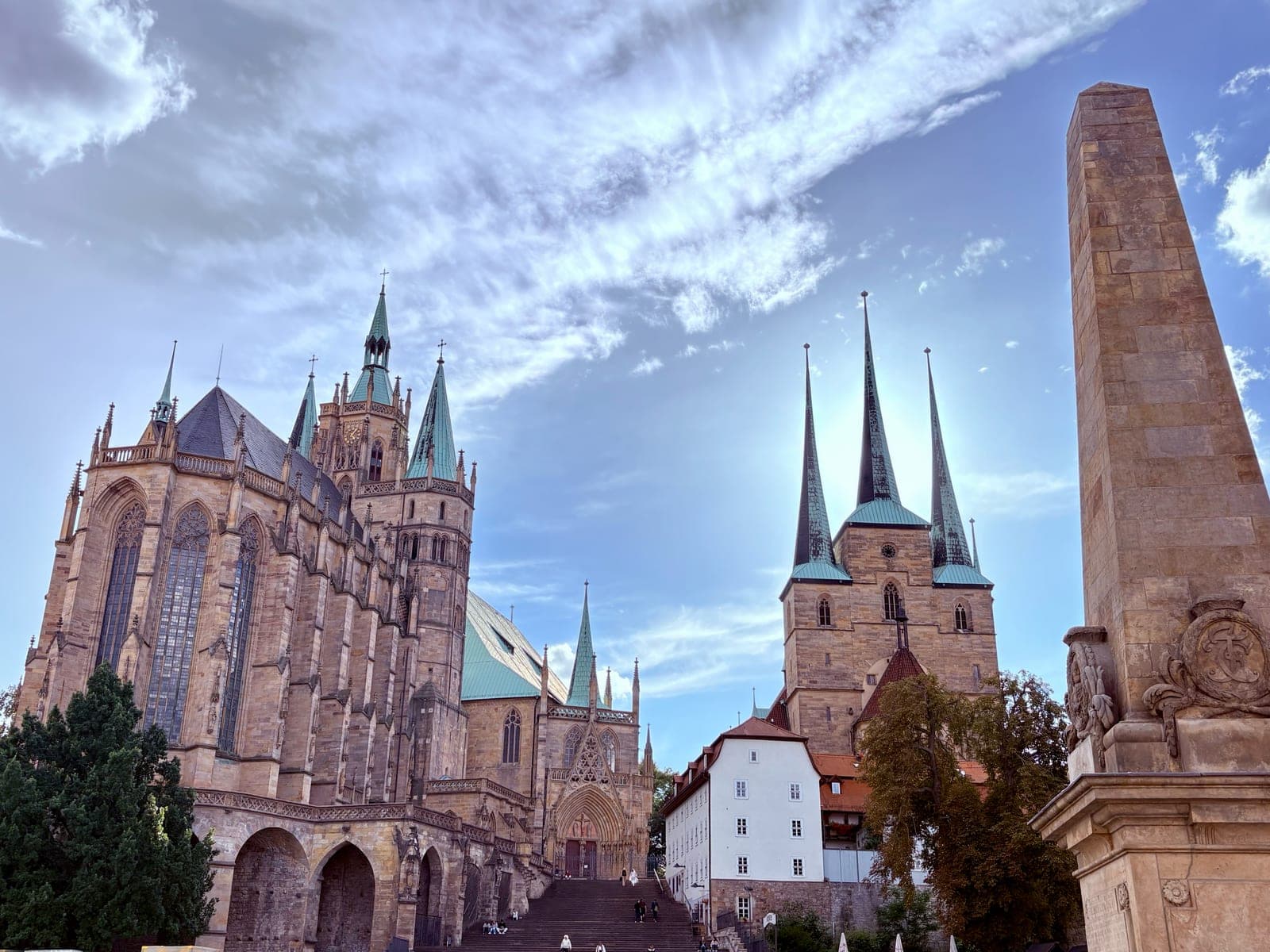
Erfurt
20 kmErfurt, the capital of Thuringia, lies twenty kilometres west of Weimar, and a direct train covers the distance in about fifteen minutes — close enough to see both cities on one trip. Boniface named it as a bishop's seat in 742, woad and the royal trade road made it one of the great cities of the medieval empire, and its largely intact old town is protected as a monument in its entirety: the cathedral and the Severikirche above the Domplatz, the Krämerbrücke lined with houses, the baroque citadel on the Petersberg, the Old Synagogue at the heart of a UNESCO World Heritage site, and the Augustinian monastery Martin Luther entered in 1505. Wieland taught at its university, Goethe belonged to the circle of its governor Dalberg, and in 1808 Napoleon met the Russian tsar here at the Congress of Erfurt.
Explore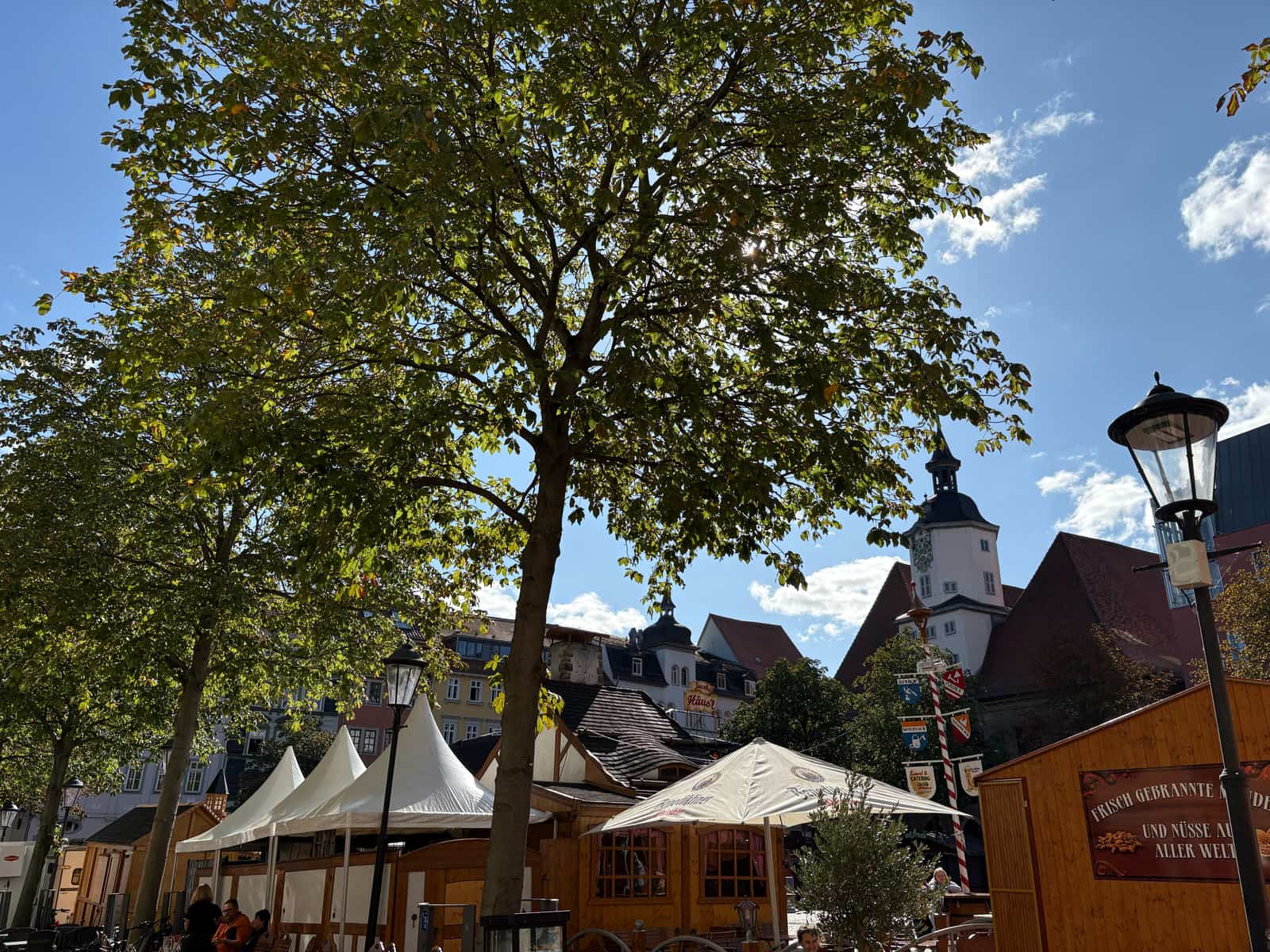
Jena
19 kmJena lies about 19 kilometres east of Weimar in the middle Saale valley, between wooded slopes of limestone and sandstone, and it has been a university city since 1558. Around 1800 this small town of some 4,000 people and 800 students was what Goethe called a warehouse of knowledge, drawing scholars and philosophers from every German-speaking land, and from 1796 the young rebels of early Romanticism. Schiller taught here, and here Goethe and Schiller began their friendship in 1794. In 1846 Carl Zeiss opened his optical workshop, which with Ernst Abbe and Otto Schott made the name world-famous. That tradition is why Jena calls itself the Lichtstadt, the City of Light, the cradle of the optical industry in Europe. For a visitor from Weimar it is a short trip to a lively university town: the market with the Rathaus and the Hanfried, the Stadtkirche St. Michael, the rooms where Goethe did his science, and the JenTower above it all.
ExploreAll towns and communities, by distance
Gotha
43 kmGotha, forty-odd kilometres west of Weimar, was a market town for nine centuries before Duke Ernst the Pious made it a residence in 1643 and built one of Germany's most significant seventeenth-century palaces over its ruined castle. The palace never needed enlarging, so its original rooms survive largely as built, and the town it looks down on still turns on the market square it had long before the palace arrived.
Highlights:
- Schloss Friedenstein, one of Germany's most significant seventeenth-century palace complexes, built 1643–1654
- The Ekhof-Theater inside the palace's west tower, one of the oldest working baroque stage machineries anywhere
- +3 more
Mühlhausen
67 kmMühlhausen, some sixty-seven kilometres northwest of Weimar, was the first town in Thuringia to hold town rights and grew into a free imperial city answering to no lord but the emperor. Its medieval wall still rings much of the old town, its tallest church became the base of Thomas Müntzer's short-lived revolutionary government in 1525, and its organist for one year, 1707 to 1708, was a young Johann Sebastian Bach.
Highlights:
- The Divi-Blasii-Kirche, Bach's church as organist from 1707 to 1708
- The Marienkirche, Thuringia's second-largest church, where Thomas Müntzer preached and governed in 1525, now the Museum St. Marien and Müntzer memorial
- +3 more
Not a town but a rural municipality of nineteen villages, formed in 2019 on the northern slope of the Ettersberg — the wooded hill that carries both Schloss Ettersburg and the Buchenwald memorial on its far side. About nine thousand people live in it.
Highlights:
- Nineteen villages, together since 1 January 2019
- Schloss Ettersburg, on the hill above
- +2 more
Apolda cast bells for two and a half centuries, and sent more than twenty thousand of them into the world — including the largest in Cologne Cathedral. The foundries are gone, the museum that explains them is not, and the town has two further claims that nobody expects: a car marque and a breed of dog.
Highlights:
- The bell museum, founded in 1952, on the cultural history of the bell
- The Glockengießerstraße, where the first foundry stood from 1722
- +2 more
Arnstadt can date itself further back than any other town in Thuringia: a donation charter of 704 names the spot, and the church built on it still stands. Eighteen-year-old Johann Sebastian Bach got his first job here in 1703, testing a brand-new organ and then playing it for four years. A baroque princess spent thirty-five years building a doll city inside her palace, and the town still shows it off. Between a Romanesque-Gothic church, a Renaissance town hall square and Bach's own organ loft, Arnstadt packs a lot of Thuringian history into a walkable old town.
Highlights:
- The Bachkirche, where 18-year-old Bach held his first organist post from 1703 to 1707
- The Neues Palais and its Mon-plaisir doll city, built by Princess Auguste Dorothea
- +2 more
The spa in the Ilm valley that Weimar built for itself. Sulphur springs were found here in 1813, Duke Carl August ordered a bath house, and Goethe helped lay out the spa grounds — which is why a small town twelve kilometres upriver has a building by the court architect at the edge of its park.
Highlights:
- The Coudray-Haus, opened on 24 June 1825 before the whole Weimar court
- A spa laid out with Goethe's involvement after the springs were found in 1813
- +2 more
Salt made this town and brine keeps it. Sulza boiled salt from the sixteenth century, discovered in the nineteenth that people would pay to bathe in the same brine, and has been a state-recognised salt spa since 2004 — with a wine festival and Thuringia's only wine gate on the side.
Highlights:
- The first saline works of 1554, and a second in 1623
- 1847, the birth year of the salt bath
- +2 more
A small town built around a castle that was never a princely residence — which is exactly why it is interesting. Eight documented lords held it in turn, it burned and was rebuilt in 1690, and the shape it took then is the shape it still has three hundred years later.
Highlights:
- The castle: a closed irregular oval on a Frankish site of the seventh century
- First mentioned as a town in 1252
- +2 more
Dornburg is a village of three castles gathered on one limestone bluff above the Saale — a medieval keep, a Renaissance residence and a Rococo pleasure palace — which its stewards call the city of roses and castles. Grand Duke Carl August died in 1828, and Goethe withdrew here for two months that summer, writing his Dornburg poems in the Renaissance castle's mountain room. A century after Goethe, Walter Gropius sent the Bauhaus's only ceramics workshop out here instead of to Weimar, to the working pottery of the master potter Max Krehan, twenty-five kilometres from the school's own buildings.
Highlights:
- The Dornburger Schlösser: an Old Castle, a Renaissance castle and a Rococo palace on one bluff, with terraced gardens over the Saale
- The Renaissance castle's mountain room, where Goethe lived from July to September 1828 and wrote the Dornburg poems
- +1 more
Eisenach lies where the Thuringian Forest meets open country, under a castle that has watched over it for close to a thousand years. It was a residence city of the Landgraves of Thuringia and later of the Dukes of Saxony-Eisenach, and it raised two names that reach far beyond Thuringia: Martin Luther boarded here as a schoolboy and came back decades later to hide and translate; Johann Sebastian Bach was born here in 1685. The Wartburg, the Lutherhaus and the Bachhaus keep all three chapters open to a visitor.
Highlights:
- The Wartburg, a UNESCO World Heritage castle on the hill above the town since 1999
- The Lutherhaus, where Luther boarded as a Latin-school pupil from 1498 to 1501
- +3 more
Freyburg is a wine town on the Unstrut, at the centre of the Saale-Unstrut wine region and a state-recognised resort, a few kilometres from Naumburg. A castle Ludwig der Springer built around 1090 to hold the eastern edge of his lands, the same purpose the Wartburg served in the west, still stands over the town. Two brothers named Kloss started a wine business here in 1856 that became Rotkäppchen, Germany's best-selling sparkling wine; and Friedrich Ludwig Jahn, the founder of German gymnastics, built his own house here and is buried in its grounds.
Highlights:
- Schloss Neuenburg, built around 1090, the Wartburg's sister castle in the east, with a Romanesque double chapel on the Straße der Romanik
- The Rotkäppchen Sektkellerei, founded 1856, Germany's leading sparkling wine brand, with tours through the historic cellars
- +1 more
Three hundred and eighty-five people, a reservoir built for recreation in the GDR years, and more than forty relocated historic buildings that make up Thuringia's largest open-air museum.
Highlights:
- The Thüringer Freilichtmuseum, founded in 1979
- Thuringia's oldest post mill, among more than 40 buildings
- +2 more
Ilmenau sits in the Ilm valley at the edge of the Thuringian Forest, under the Kickelhahn, its home mountain. Goethe came here 26 times between 1776 and 1831, not as a visitor but as the official who reopened the town's copper and silver mines and reformed its tax system; the rooms he used are a museum today, and a small shelter on the mountain above the town carries the poem he wrote there in 1780. Since 1894 the town has also been home to a technical university, with some four thousand students today.
Highlights:
- The Goethehäuschen on the Kickelhahn, where Goethe wrote "Über allen Gipfeln ist Ruh" in 1780
- The GoetheStadtMuseum, in the rooms Goethe used across 26 official visits
- +2 more
Sixteen villages strung along the Ilm downstream of Weimar, administratively one municipality since the 2019 reforms. Two of them matter to anyone following Weimar's writers and musicians: Oßmannstedt, where Wieland lived and is buried, and Denstedt, whose church organ Liszt used for teaching.
Highlights:
- Oßmannstedt — Wieland's estate and his grave
- Denstedt, whose church has the Liszt organ
- +2 more
A small town with two castles above it, which is one more than a place this size should have — and the reason is that Kranichfeld spent four and a half centuries divided between two lordships that did not like each other.
Highlights:
- The Oberschloss and the Niederburg, one town, two castles
- First named in a document of 1143
- +2 more
Meiningen became the capital and residence of the Duchy of Saxony-Meiningen in 1680, and the palace its dukes built still stands over the town, now the home of the Meininger Museen. Its real export was theatre: from the 1870s Duke Georg II sent his own acting troupe, the Meininger, on tour across Europe with a staging style so exact it changed how directors everywhere thought about the stage, and the court orchestra under Hans von Bülow drew Brahms, Richard Strauss and Max Reger to its podium.
Highlights:
- The Staatstheater Meiningen, where the Meininger troupe reinvented stage direction
- Schloss Elisabethenburg, the ducal palace, now the home of the Meininger Museen
- +2 more
Naumburg is a cathedral and wine city on the Saale, in Saxony-Anhalt rather than Thuringia, at the centre of Germany's northernmost quality wine region. Its cathedral has carried UNESCO World Heritage status since 2018, for stonework the anonymous Naumburg Master carved in the thirteenth century — twelve life-sized founder statues, Uta of Naumburg among them, long called Germany's“most beautiful woman of the Middle Ages”. Friedrich Nietzsche grew up here from 1858, at the house on the Weingarten his family kept for the rest of his life, and returned to it, ill, after his collapse in 1889.
Highlights:
- The Naumburg Cathedral of Sts Peter and Paul, UNESCO World Heritage since 2018
- Uta and Ekkehard II, the founder statues in the west choir, carved by the Naumburg Master around 1250
- +2 more
A village of a few hundred people west of Weimar with two things behind it that nobody expects: a reception committee for Martin Luther in 1521, and an airfield that ran from the First World War until the Soviet army left in 1992.
Highlights:
- Luther received here on 5 April 1521, on his way to Worms
- St Peter's church, first mentioned in 1303, its tower 38 metres high
- +2 more
Rudolstadt sits in a wide bend of the Saale, under the Baroque palace its princes built on the hill above the old town. In the summer of 1788 the writer Friedrich Schiller lodged here, fell for a local woman, and met Johann Wolfgang von Goethe for the first time in the house where she lived — a meeting that grew, six years later in Jena, into one of German literature's defining friendships. Every July the town fills again for the Rudolstadt-Festival, Germany's largest folk and world-music festival.
Highlights:
- The Heidecksburg, the Schwarzburg-Rudolstadt princes' Baroque residence on the hill
- The Schillerhaus, where Schiller and Goethe first met on 7 September 1788
- +2 more
Schmalkalden gave its name to the Schmalkaldic League, the alliance of Protestant princes and cities that met here eight times from December 1530 to defend the Reformation. Martin Luther came for the League's most important assembly in February 1537 and wrote his Schmalkaldic Articles in a half-timbered house that still stands. A Renaissance palace built a generation later, Schloss Wilhelmsburg, now tells that history in the rooms where some of the meetings themselves were held.
Highlights:
- Schloss Wilhelmsburg, the Renaissance palace and the Schmalkaldic League museum
- The Lutherhaus, where Luther wrote the Schmalkaldic Articles in February 1537
- +2 more
Planning Your Visit
• Most towns are 15-30 minutes drive from Weimar
• Public transportation available to major towns
• Perfect for half-day or full-day excursions
• Each town offers unique cultural experiences
• Combine multiple towns for a countryside tour
Regional Highlights
• Apolda: Bell-making heritage and industrial history
• Bad Berka & Bad Sulza: Spa towns and wellness
• Blankenhain: Agricultural museum and castle
• Ilmtal-Weinstraße: Wine region and vineyards
• Kranichfeld: Medieval castle and old town